
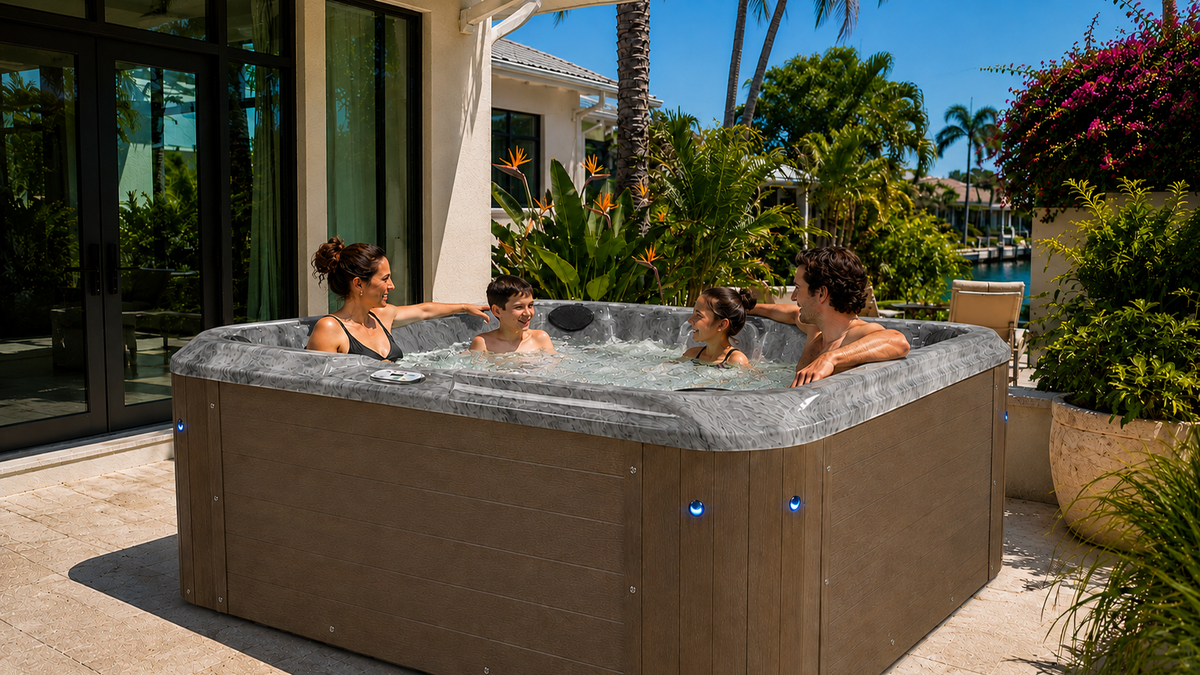
A hot tub can provide relaxing family time, but it also presents risks that require careful planning. Warm water, slippery surfaces, powerful suction outlets, and easy access can become dangerous when children are nearby.
No safety device or rule can eliminate every risk. The best approach is to combine constant adult supervision with secure access barriers, properly maintained equipment, safe water temperatures, and clear family rules.
Can Children Use a Hot Tub Safely?
Children under 5 years old should not use hot tubs, according to current guidance from the Centers for Disease Control and Prevention.
Older children should use a hot tub only with close adult supervision and when their health, maturity, and ability to follow safety rules make it appropriate.
Being able to stand on the bottom is not enough to make a child safe. A child can slip, become disoriented, overheat, or become trapped by suction. Knowing how to swim also does not eliminate the risk of drowning.
Ask your child’s healthcare provider before hot tub use if the child has a medical condition, takes medication, has difficulty regulating body temperature, or has experienced fainting, seizures, breathing problems, or heart-related symptoms.
1. Provide Constant, Undistracted Supervision
Never leave a child alone in or near a hot tub—not even briefly.
Designate one responsible adult as the Water Watcher. That person should actively watch the children and should not:
- Read
- Text or scroll on a phone
- Prepare food
- Drink alcohol
- Sleep or relax with closed eyes
- Leave to answer a door or complete another task
If supervision needs to change, the adults should verbally confirm who is taking over. Do not assume another adult is watching.
For a child who is not a strong swimmer, the supervising adult should remain in the water and within arm’s reach. An older sibling should never be placed in charge of a younger child.
Flotation devices and swimming ability are not substitutes for adult supervision.
2. Prevent Unsupervised Access
Children can reach water unexpectedly, so supervision during use is only one part of hot tub safety.
When the spa is unattended:
- Close the cover completely.
- Fasten every locking strap or clip.
- Keep cover keys where children cannot reach them.
- Use door alarms or other access alerts where appropriate.
- Secure nearby steps if they can provide access.
- Follow all local fencing and barrier requirements.
The U.S. Consumer Product Safety Commission recommends multiple layers of protection, which may include a fence at least four feet high, a self-closing and self-latching gate, door alarms, and a properly maintained pool or spa cover.
A standard insulated hot tub cover may help discourage access, but it should not automatically be treated as a childproof safety barrier. Use a cover designed and rated for its intended safety purpose, and inspect its straps, locks, hinges, and attachment points regularly.
Never allow children to sit, stand, walk, or play on the cover. Replace a cover that is sagging, waterlogged, damaged, or unable to lock securely.
3. Follow Age and Temperature Guidance
Children under 5 should not use hot tubs.
For older children, the water temperature should never exceed the maximum stated in the owner’s manual or 104°F, whichever is lower. The CDC identifies 104°F as the maximum hot tub water temperature, but that maximum should not be treated as a target for children.
Use a reliable thermometer or the spa’s properly functioning temperature display. Consider lowering the water temperature for family use and keeping each session brief.
There is no single soak time that is appropriate for every child. Age, water temperature, health, activity level, and individual heat tolerance all matter. Ask the child’s healthcare provider for personalized guidance when uncertain.
Have children leave the water immediately if they experience:
- Dizziness
- Headache
- Nausea
- Unusual sleepiness
- Confusion
- Weakness
- Flushed skin
- Rapid breathing
- Difficulty standing
- Feeling excessively hot
Move the child to a cool area and seek medical help when symptoms are severe, persist, or involve altered consciousness or breathing difficulty.
4. Encourage Hydration and Cooling Breaks
Hot water can raise body temperature and contribute to fluid loss.
Offer drinking water before and after the soak, and keep water available nearby in a shatter-resistant container. Schedule regular breaks away from the spa so children can cool down.
Drinking water does not make an overly hot or lengthy soak safe. Temperature, exposure time, symptoms, and supervision still need to be managed.
Do not allow children—or supervising adults—to consume alcohol before or during hot tub use.
5. Keep Children Away From Drains and Suction Outlets
Spa drains and suction fittings can create an entrapment hazard. Hair, limbs, jewelry, and parts of a swimsuit may become caught.
Teach children to:
- Stay away from drains and suction outlets.
- Never sit on a drain cover.
- Never insert fingers or toes into fittings.
- Avoid putting their head underwater near suction outlets.
- Stop playing immediately if an adult gives a safety instruction.
Tie back long hair securely and remove loose jewelry before entering.
Inspect every drain and suction cover regularly. Never use the hot tub if a cover is loose, broken, missing, recalled, or otherwise damaged. The CPSC advises owners to use compliant drain covers and teach children to stay away from drains.
Adults should also know where the pump shutoff or emergency disconnect is located and how to stop the equipment during an emergency.
6. Prevent Slips and Falls
Water around a hot tub can make decks, patios, and steps slippery.
Reduce fall risks by:
- Using stable, slip-resistant steps
- Installing a compatible handrail when appropriate
- Keeping the surrounding area well lit
- Repairing loose boards, pavers, or railings
- Removing toys, hoses, and other tripping hazards
- Cleaning slippery buildup promptly
- Requiring children to walk rather than run
Children should enter and exit one at a time. Do not allow jumping, diving, pushing, or climbing over the side.
The cover lifter, equipment compartment, and surrounding furniture should never be used as climbing structures.
7. Maintain Clean, Balanced Water
Warm water can support rapid germ growth when the hot tub is not maintained correctly. Children may become ill through contact with contaminated water, swallowing it, or breathing contaminated mist.
Before use, confirm that the water is clear, properly circulating, and within the ranges required by the owner’s manual and sanitizer label.
Current CDC guidance recommends:
- At least 3 parts per million of chlorine
- 4–8 parts per million of bromine
- A pH between 7.0 and 7.8
Do not use the hot tub if:
- The water is cloudy
- The sanitizer or pH is outside the recommended range
- The spa has a strong or unusual odor
- The surfaces feel sticky or unusually slippery
- Circulation is not working
- You cannot see the bottom clearly
Ask everyone to shower before entering and discourage children from swallowing the water.
Anyone experiencing diarrhea should stay out of the hot tub. Follow your water-care instructions after heavy use or any contamination incident.
8. Store and Use Spa Chemicals Safely
Hot tub chemicals can cause burns, poisoning, breathing problems, or eye injuries when handled incorrectly.
Protect children by following these rules:
- Store chemicals in their original labeled containers.
- Keep them locked and out of children’s reach.
- Store them in a cool, dry, well-ventilated location.
- Never store chemicals inside the spa equipment compartment.
- Never mix chemicals.
- Never reuse chemical containers for another purpose.
- Follow every product label and the spa owner’s manual.
- Keep children away while chemicals are measured or added.
- Never add chemicals while anyone is in the water.
After treating the water, follow the product instructions regarding circulation, ventilation, testing, and how long to wait before entering.
If a chemical is swallowed, inhaled, or splashed into the eyes or onto the skin, follow the product label and contact Poison Control or emergency services as appropriate.
9. Keep Electrical Devices Away
Do not place corded electrical devices near the hot tub. Extension cords, radios, chargers, lamps, and other household electrical equipment can create an electrocution hazard around water.
Use only spa components installed and operated according to the manufacturer’s instructions.
Phones and tablets can also distract the designated Water Watcher, even when the devices are battery-powered. Active supervision should remain the adult’s only responsibility.
10. Prepare for an Emergency
Every household with a pool or spa should have an emergency plan.
Adults and regular caregivers should know:
- How to perform CPR on children and adults
- How to call emergency services quickly
- How to turn off the spa’s pumps
- How to remove the cover rapidly
- Where rescue equipment is stored
- Who is responsible for supervising the water
Keep a charged phone nearby for emergencies, but not as a source of distraction.
If a child is missing, check the hot tub, pool, and other nearby water first. Seconds matter.
Call emergency services immediately if a child is unresponsive, has trouble breathing, experiences a suspected drowning incident, or may be trapped by suction. Turn off the pumps during a suspected entrapment emergency.
Family Hot Tub Safety Rules
Post a short list of rules where everyone can see it:
- Children under 5 do not enter the hot tub.
- No child enters without permission and adult supervision.
- The designated Water Watcher stays attentive.
- Walk—never run—around the spa.
- No diving, jumping, pushing, or horseplay.
- Stay away from drains and suction outlets.
- Keep long hair tied back.
- Do not swallow the water.
- Get out immediately if you feel dizzy, sick, sleepy, weak, or too hot.
- Keep food, glass, corded electronics, and chemicals away.
- Replace and lock the cover after every use.
- Tell an adult immediately if a cover, drain, step, or other component is damaged.
Review the rules regularly instead of assuming children will remember them.
The Bottom Line
A hot tub can be part of family life, but children require additional protection around warm water.
Do not allow children under 5 to use a hot tub. For older children, combine close adult supervision with a lower water temperature, brief exposure, cooling breaks, clean water, properly maintained drain covers, and clear rules.
When the spa is not in use, lock the cover and maintain additional barriers that prevent unsupervised access. Remember that covers, fences, alarms, swimming lessons, and flotation devices are layers of protection—not replacements for attentive adult supervision.
If you are uncertain whether hot tub use is appropriate for your child, consult the child’s healthcare provider before allowing them to enter.

Learn more:


Share:
Hot Tub Chemical Safety: 12 Essential Rules for Spa Owners
What Is a Hot Tub Ozonator and How Does It Work?