
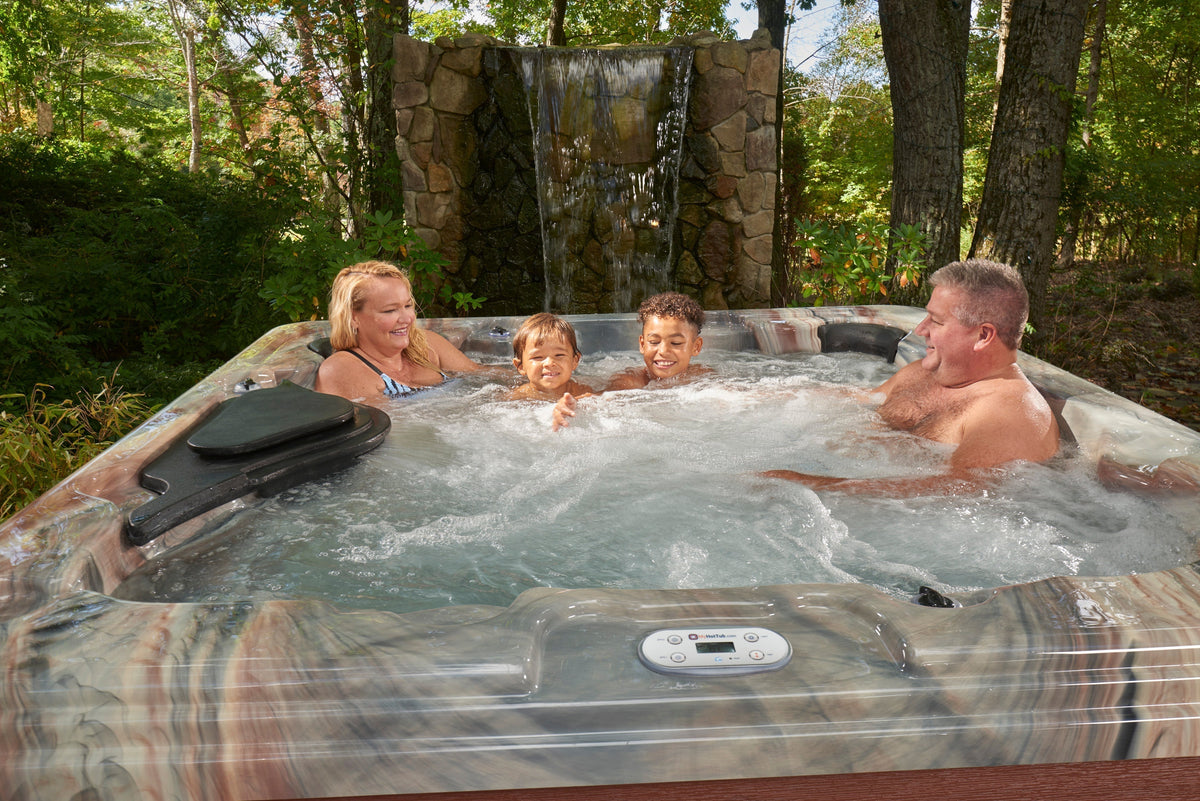
Choosing the right hot tub size involves more than counting seats. The spa must comfortably accommodate the people who will use it, fit its installation site, travel through the delivery route, and leave enough room for steps, a cover lifter, and future maintenance.
A hot tub that is too small may feel crowded. One that is unnecessarily large may occupy more space, hold more water, and cost more to purchase and operate.
Before falling in love with a particular model, answer the following questions.
How Many People Will Use the Hot Tub?
Begin with the number of people who will use the spa regularly—not the maximum number you might invite once or twice a year.
Consider:
- How many people live in your household?
- Will everyone typically use the spa together?
- Will you frequently entertain friends or relatives?
- Do you prefer sitting close together or having extra personal space?
- Might your household’s needs change over the next several years?
A couple may enjoy a compact spa with extra room to stretch out, while a family of five may need a larger model with open seating. If entertaining is important, choosing one or two additional seats can give guests more flexibility.
However, buying for a rare occasion may not be worthwhile. If two people will use the hot tub most of the time, an eight-person spa may require more space and water than you need.
Does the Advertised Seat Count Equal Comfortable Capacity?
A hot tub’s listed capacity tells you how many designated seating positions it contains. It does not guarantee that every group will find those seats equally spacious.
Comfort depends on:
- The width and depth of each seat
- The amount of footwell space
- The height and body type of each person
- The position of armrests, jets, and molded contours
- Whether the spa has upright seats, loungers, or both
- How much personal space each person prefers
A spa advertised for six people may feel roomy for four adults and cozy at its full capacity. Another six-person model with a large footwell and open bench-style seating may accommodate a group differently.
Use the listed capacity as a starting point rather than the only deciding factor.
Lounger or Open Seating?
Seating configuration can be just as important as the spa’s exterior dimensions.
Lounger Hot Tubs
A lounger allows one person to recline with support for the back and legs. It may be a good choice if you want:
- A full-body hydrotherapy position
- Space to stretch out
- Jets directed toward the legs and feet
- A more reclined soaking experience
Because a lounger occupies more of the spa’s interior, it may reduce the number of upright seats or the amount of shared footwell space.
Body height also matters. A lounger that fits one person perfectly may feel too long or too short for another. Some bathers also experience floating in certain lounge seats.
Non-Lounger Hot Tubs
An open or non-lounger layout usually provides more upright seating and shared footwell space. It may work better for:
- Families and larger groups
- Socializing and entertaining
- People who prefer upright seats
- Households with bathers of different heights
- Buyers who want the greatest seating flexibility
If possible, sit in an empty display model or arrange a wet test before buying. This is the best way to judge seat depth, jet placement, footroom, and ease of entry.
Is There a Standard Hot Tub Size?
There is no single standard hot tub size.
Spas are available in rectangular, square, round, and other configurations. Their dimensions vary according to seating, shell design, equipment, insulation, and construction.
Even two models with the same advertised capacity can have very different exterior dimensions and interior layouts.
Current MyHotTub models illustrate this variety:
- The Terra seats three to four people in a compact rectangular footprint.
- The Luna seats up to five in a roughly square footprint.
- The Corona offers seating for five to six in a round design.
- Larger acrylic models offer additional seating space, equipment, and hydrotherapy features.
Always use the exact specifications for the individual model you are considering. Do not estimate fit based solely on its seating capacity or product category.
How Much Space Does a Hot Tub Need?
Measure the complete installation area before shopping.
Record:
- Available length
- Available width
- Overhead clearance
- Distance from the house and property lines
- Distance from doors, windows, and utilities
- Space around railings, landscaping, and outdoor furniture
Compare those measurements with the spa’s exact exterior dimensions.
The spa should not simply squeeze into the available footprint. You may also need room for:
- Hot tub steps
- A cover lifter
- Opening and folding the cover
- Safe entry and exit
- Access to the equipment compartment
- Drainage and water runoff
- Electrical equipment and a disconnect
- Routine maintenance and future repairs
Clearance requirements vary by spa, cover-lifter design, installation type, and local regulations. Review the pre-delivery guide and owner’s manual before finalizing the location.
A full-size cardboard outline or painter’s-tape template can help you visualize the spa’s footprint. Place chairs inside the outline to approximate seating and walk around it to evaluate access.
Will the Hot Tub Fit Through the Delivery Route?
A spa can fit perfectly on the patio and still be impossible to deliver through a narrow gate.
Measure the entire route from the delivery point to the prepared foundation. Check:
- Gates and doorways
- Side yards
- Fence openings
- Roof overhangs
- Tree branches
- Air-conditioning units
- Outdoor stairs
- Tight corners
- Changes in elevation
- Overhead wires
- Deck railings
Ask whether the spa will be transported flat or on its side, and include the packaging and delivery equipment in your clearance calculations.
If the route cannot accommodate the spa, professional delivery equipment or a crane may be required. Confirm these details and related costs before ordering.
Can the Foundation Support the Filled Spa?
Dry weight is only part of the equation. Once filled, a hot tub must support the weight of the spa itself, hundreds of gallons of water, and every occupant.
For example, MyHotTub’s Luna weighs approximately 285 pounds dry but more than 2,000 pounds when filled, before bathers are added.
The spa must sit on a level, stable foundation designed for its total filled weight. Appropriate options may include a properly constructed concrete pad or another surface approved by the manufacturer.
Never assume an existing deck can support a hot tub. Have a qualified structural professional evaluate elevated decks and other questionable surfaces before installation.
A larger spa generally holds more water, increasing its filled weight and foundation requirements.
Consider the Spa’s Height
Length and width receive most of the attention, but height also affects comfort and installation.
A deeper spa may provide:
- More shoulder coverage
- Deeper seating
- Greater water capacity
- A more immersive soak
A lower-profile spa may be easier for some people to enter and may fit better beneath a window, railing, or other obstruction.
Consider the needs of shorter adults, older users, children, and anyone with limited mobility. Compatible steps and handrails may make entry and exit easier, but they also require additional installation space.
Resin or Acrylic: Does Material Determine Size?
Material alone does not determine a hot tub’s size or capacity.
MyHotTub offers resin and acrylic spas in several footprints and seating configurations. The categories differ in construction, styling, available features, electrical requirements, and price, but there is meaningful overlap in their dimensions and capacities.
Rather than assuming one material will always be smaller, compare individual models based on:
- Exact exterior dimensions
- Seating layout
- Water capacity
- Dry and filled weight
- Electrical requirements
- Jet configuration
- Included features
- Available options
- Warranty coverage
Choose the material and model that best match your priorities.
Consider Electrical and Equipment Requirements
Spa size and equipment often affect the required electrical service.
Some compact and midsize models offer 120-volt plug-and-play operation. Other models require a dedicated 230- or 240-volt hardwired circuit installed by a qualified electrician.
A larger spa may also include additional pumps or more powerful equipment. Before purchasing, confirm:
- Available electrical service
- Required voltage and amperage
- Location of the GFCI and disconnect
- Distance from the electrical panel
- Estimated installation cost
- Local permitting and inspection requirements
Electrical work can materially affect the total project budget, so obtain an estimate before selecting the spa.
Establish a Complete Budget
The purchase price is only one part of a hot tub project.
Your budget may also need to cover:
- Site preparation
- Electrical installation
- Professional placement
- Crane service, if required
- Steps and handrails
- A cover lifter
- Water-care products
- Delivery upgrades
- Permits or inspections
- Ongoing water and electricity use
A larger spa may cost more to purchase, prepare for, fill, and maintain. Compare the complete installed cost rather than the advertised spa price alone.
If paying over time would help you choose the model that fits your needs, MyHotTub offers hot tub financing options. Available plans, interest rates, payments, and approval requirements can vary, so review the complete financing terms before applying.
A Simple Hot Tub Sizing Guide
Use this table as a starting point—not a substitute for reviewing individual specifications.
|
Your usual group |
What to consider |
|
One or two people |
A compact spa, lounger, or model with extra room for two |
|
A couple with occasional guests |
Four or five designated seats |
|
A family of four or five |
A model with sufficient seats and a generous footwell |
|
A larger household |
Six or more designated seating positions |
|
Frequent entertaining |
Open seating, additional capacity, and easy access around the spa |
|
Hydrotherapy-focused use |
Seat depth, jet placement, and whether a lounger fits your body |
|
Limited installation space |
Exact footprint, equipment access, cover clearance, and delivery route |
Choosing one extra seat can provide useful flexibility. Choosing several more seats than you will normally use may add size and cost without improving your everyday experience.
Hot Tub Measurement Checklist
Before ordering, confirm all of the following:
- The spa accommodates your regular number of bathers.
- The seats and footwell feel comfortable.
- The exterior dimensions fit the prepared site.
- There is room for steps and the cover lifter.
- The equipment compartment will remain accessible.
- The complete delivery route has sufficient clearance.
- The foundation supports the spa’s total filled weight.
- The required electrical service is available.
- The installation complies with local requirements.
- The complete project fits your budget.
- You have reviewed the delivery, cancellation, and return terms.
Do not rely on the possibility of returning a spa that does not fit. Return freight, preparation requirements, eligibility rules, and other conditions may apply.
Find the Hot Tub That Fits Your Life
The right hot tub is not necessarily the largest model you can afford or the smallest one that fits your patio. It is the spa that provides the right balance of seating, comfort, features, installation requirements, and long-term cost.
Start by measuring your site and delivery route. Next, determine how many people will use the spa regularly and whether you prefer a lounger or open seating. Then compare the exact dimensions, weights, electrical requirements, and layouts of the models that meet those needs.
Taking these steps before ordering can help you choose a hot tub that fits your home—and the way you plan to enjoy it—for years to come.


Share:
What Is Hot Tub Hydrotherapy?
Can You Use a Hot Tub Without Chemicals?